The Sparked Group · AI implementation & automation
Put AI to work across your business.
We build and run AI workflows that connect your systems, reduce manual work and help your teams get more done. Across marketing, sales, customer service, reporting and internal operations, we start with the work that needs improving.
Start with one workflow. Build around the systems you already use.
The work between the tools
Your systems hold the data. Your people still join the dots.
Copying updates between systems. Chasing the next step. Rebuilding the weekly report. AI becomes useful when it takes that work off your team's hands, with clear rules for when a person needs to step in.
Connect
Work moves between teams
Link the systems and handovers that currently depend on someone remembering to do them.
Automate
Routine tasks take less time
Prepare the update, gather the context and route the request. Keep human review where it matters.
Adopt
Your team knows how to use it
Build around real working habits, with training, a named owner and support after launch.
What we build
Start where the work gets stuck.
We design, build and support workflows for the people using them. These are the kinds of work we can help you improve.
Revenue & customers
Make the next step happen
Enquiry routing, account research, follow-up preparation and customer handovers, connected to your CRM.
From a useful first workflow to a team that can rely on it.
One team stays with you through planning, delivery and adoption. We agree what success means before the build, then review what changes in practice.
01
Assess and plan
Map the task, systems, people and constraints. Choose a first workflow with a clear owner, baseline and agreed scope.
02
Build and connect
Develop the workflow in your environment. Test real scenarios, permissions and exceptions with the people who will use it.
03
Embed and improve
Train the team, monitor the work and review the results. Agree ongoing support and expand when the first workflow earns it.
A workflow example · customer enquiries
The enquiry arrives. The right person gets the context.
An incoming request can trigger a check of the customer record, a short summary and a suggested response. The workflow routes it to the right person and records what happened.
The workflow handles
Gathering the relevant information from approved systems
Preparing a summary and suggested next step
Routing the request and logging the activity
Your people decide
Which information and systems it can access
What needs approval before anything is sent
How exceptions are handled and success is measured
Illustrative workflow. The tools, permissions and approval steps are agreed for each engagement.
Explore the work
See what it looks like in practice.
Our most developed examples are in revenue operations, reporting and internal tools. Explore the interfaces and approach, then talk through what would fit your business.
Eight in all, including a physics toy and a resignation letter to copying and pasting. See the whole playground →
Before we start
Clear scope. Clear ownership. People in control.
What does The Sparked Group do?
We design, build and support AI workflows and internal tools that connect business systems and reduce manual work. Planning, implementation and team adoption are part of the same engagement.
Do we need to replace our existing systems?
We start with the systems you already use. The assessment checks data quality, access and integration options before we recommend what to connect or change.
How do you keep people in control?
We agree permissions, approval steps, escalation rules and a named owner for each workflow. Testing, activity records and monitoring are part of the delivery plan.
What happens after launch?
We agree training, documentation, monitoring and ongoing support as part of the scope. Ownership, hosting, third-party software and AI usage costs are made clear before work starts.
How do we get started?
Select a time to discuss the work you want to improve. You can also send a short brief through Find your starting point. We review it personally and suggest the next step.
What work would you improve first?
Bring one process, one bottleneck or one idea. We will help you find a practical starting point.
The Sparked Group · Products · ProofPin.app · Live
Make feedback effortless.
Upload the work, share one link, and your client pins comments exactly where they belong. No sign-ups for reviewers, no forty-reply email chains. Clear feedback, clean sign-off.
The Sparked Group · Products · Client delivery for agencies
Client work, clear from request to sign-off.
HoopoeHQ gives your agency and its clients one place for requests, progress, files and approvals. Clients can see what is happening and when work is due, with feedback attached to the work itself.
The Sparked Group · Products · Orbitable.ai · Live
Strategy to pipeline, automated.
Orbitable is the agentic go-to-market command centre. 52 agents across 10 specialist squads research, write, launch and report, with approvals where they matter and autonomy where they don't. Your team keeps the judgement. The platform does the legwork.
Not another point tool. Orbitable replaces the stack of twelve with squads that share one plan, one data spine and one definition of the truth.
The roster
10 specialist squads
Strategy, ICP and segmentation, content, brand, paid, ABM, SDR, RevOps, customer success and reporting. Each squad runs as a coordinated unit.
The workflow
Strategy to pipeline
From market research and ICP definition through content and outreach to deal scoring and forecast. One connected workflow, one version of the truth.
The plumbing
MCP-native
Every agent is callable from Claude, ChatGPT, or your Make and n8n stack through Orbitable's MCP server. Bring your tools, plug in the agents.
How it works
Three moves from brief to pipeline.
01
Tell it what you sell, to whom, and why
A short onboarding captures your ICP, positioning and goals. The Strategy squad turns it into a plan.
02
Squads pick up the work
Content, paid, SDR, ABM, RevOps. Each squad executes against the plan, coordinated by the orchestrator. Approvals where they matter, autonomy where they don't.
03
Your CRM fills, your forecast sharpens
Pipeline appears. Signals route to your team with full context. The system learns and improves with each cycle.
Run on our own engine
The machinery underneath the service
Orbitable is the five-phase engine from our automation practice, productised. We run The Sparked Group's own go-to-market on it every day. When you buy the service, this is what's working underneath.
Most teams have most of the parts. Almost no one has the system. We listen, diagnose, design your engine, then build and run it. Websites, internal apps and agent integrations ship as part of the engine, from the same team, in the same room, on the same hook.
Buyers changed how they buy. Most engines didn't keep up.
Three shifts, measured by the people who track this for a living. Together they are why a revenue engine now has to run across the whole journey, not just chase leads at the top.
94%
of B2B buyers now do their research through AI tools, peers and communities, before they ever land on your website.
Forrester / 6sense, 2026
13 people
sit on the average B2B buying decision, across two departments. One rep can't reach all of them. An engine can.
Forrester · Buying Groups
2.3×
more deals close when marketing and sales work from the same buyer insight, instead of two versions of the truth.
Gartner
The biggest software platforms now teach this exact playbook from the main stage: audit the workflow, join up the data, put AI agents on it one stage at a time. We agree with all of it. The difference is simple. They sell you the software. We are the team that makes it run, inside whatever stack you already own.
What we see, every time
Most teams have pieces. Not a system.
A serious business, with serious tools, running a thousand small efforts that never compound. We open the bonnet, you nod a lot. The question is not whether to fix it. The question is which version of the engine fits where you are now.
Sales and marketing
Run as separate kingdoms. Pipeline is a hope, not a forecast.
Your CRM
A graveyard. Tools do not talk. Records do not flow. Reporting cannot be trusted.
AI inside the team
A slide deck, not a system. Promised everywhere, embedded nowhere.
Brand and demand
The brand looks fine. The demand is broken. Buyers do not remember you the week after.
Your team
Sharp, senior, working flat out. The engine they sit inside is not.
Last quarter's win
Cannot be repeated. Because no one wrote down how it actually happened.
Two pillars, one team
An engine that is built. And led.
Two halves of the same offer. Most teams need both. We deliver both, from one operator group, on one number.
Revenue Automation
The engine, built in five phases.
Brand, content, demand, CRM, AI, automation, fused into one system that compounds. We start where you are and walk you up the ladder, one phase at a time. The work shipped is the deliverable.
Strategy, design, and build, by the same operators
Sequenced so each phase pays for the next
Outputs are working systems, not slideware
Fractional Leadership
Lead the engine.
Senior CRO and CMO leadership embedded in your team. Not an agency at arm's length. Part of how you operate.
Fractional CRO and CMO, hands on the work
Embedded weekly cadence, in your stack
Board-ready commercial reporting
How we work
A custom plan, walked together. No template fitting.
Four steps before any scope, quote, or contract. The diagnosis itself is the deliverable. If we are not the right team afterwards, you keep it.
01
We listen.
An honest conversation, not a discovery deck. Goals, constraints, where it has been quietly stuck for a year. No pitch.
02
We diagnose.
We map the engine you have today against the engine your goals need: where the leaks are, where the quick wins are, and where to start.
03
We design.
Your engine, sized to your motion and your stage. Sequenced so each step pays for the next. No deck-ware.
04
We build and run.
We implement, we operate, we report. The same people who designed it. Strategy you can ship. Execution that knows why.
What sits inside the engine
One engine. Many parts.
We are not a single-channel shop. The whole point is the parts moving together. Below is the surface area. The combination, sequence, and weighting are designed for you, not borrowed from a deck.
Brand and positioning
That buyers actually remember. The work behind the line.
Content and authority
Point of view, delivered on cadence, distributed where it lands.
Demand and pipeline
Engineered demand, multi-channel. So pipeline stops depending on one heroic founder.
CRM and lifecycle
Records that flow. Stages that mean something. Reporting your board reads.
AI inside the system
Embedded into the work, not bolted on. Working for the team, not replacing it.
Fractional leadership
A senior CRO or CMO inside your team. Same operators as the build. Skin in the game.
The ladder we walk together
Five phases. One engine.
Foundation to Agentic. Each phase is a complete delivery scope that earns the next one. We start where you are, not where a deck wishes you were.
01
Foundation
Lay the groundwork.
The platform every later phase will hang off. Strategy first, plumbing second, polish third. We get the basics right before we get clever, because the clever does not work without them.
02
Signal
You see who is in market.
Intent, behaviour and product signals wired into the record. Tools start talking. Reporting begins to mean something. The team stops being the integration layer.
03
Orchestration
One motion, logged.
What happens on a signal, in what order, by whom. AI drafts next to the team, judgment stays human, and every step gets logged. AI stops being slideware and starts being where the work happens.
04
Scale
Every cycle compounds.
Repeatability takes over. Each completed cycle makes the next one cheaper, faster and better, and the playbook stops living in one person's head.
05
Agentic
Self-optimising.
The engine runs 24/7 inside the guardrails you set. Your team operates above it, not inside it. The leader gets the night back.
The full surface area
Acquisition is half the story.
A real revenue engine works on both sides of the close. Before, during, and long after. Each phase of the ladder operates across the full bowtie, not just the front.
→
Acquisition
First touch. Earn the right to be considered.
→
Conversion
Become the choice. Earn the close.
●
Onboard
First value. Earn the second renewal.
→
Expansion
Compound. Earn more from the buyer who chose you.
→
Advocacy
Word of mouth, engineered. Buyers become introducers.
All five phases operate across all five stages
How working with us actually feels
Inside your team, on your tools, on the same number.
Not an agency. Not a consultancy. Not an implementation shop. We sit between all three. Senior operators, hands on the work, accountable to the result.
Weekly
In your room.
In your Slack, on your standup, in your forecast call. Not a status report once a month.
Working in your CRM, your dashboards, your forecast view. Not over email.
With your team
Coaching alongside.
Manage your reps and marketers directly when needed. Hire alongside you. Coach the bench.
Three ways to start
Pick the door. We meet you there.
Different businesses need different first steps. Each of these is a real engagement, not a sales funnel.
Mode 01
Diagnose.
Two to four weeks. We map your engine, name what is broken, recommend where to start. The diagnosis is the deliverable. You keep it whether you work with us afterwards or not.
A clean read on the engine
Mode 02
Design and build.
A focused project, a defined scope. We design the engine and ship the first phase. You hand it off to your team or hand it back to us to operate.
A working system on day one
Mode 03
Run it with you.
Ongoing operating partnership. We hold the design, ship every phase, sit in the room. Quarterly resets, monthly reviews, weekly cadence. Skin in the game.
A team inside your team
What you walk away with
A revenue engine that compounds.
A sales engine that runs every week, not every campaign.
A marketing system with a point of view buyers remember.
AI inside the work. Not slideware on the side.
A CRM your team trusts and a forecast you can defend.
Senior leadership in the room. Not advising from afar.
A motion the next hire can step into without losing the thread.
Why us
Strategy. And execution. Same team.
Most agencies hand over a deck. Most consultants hand over a slide. Most implementation shops hand over a config. None of those, on their own, build a revenue engine.
We do the strategy and the build. Senior commercial thinking sat next to the people writing the workflows, the prompts, the agent code, the posts, the brand system, and the dashboards. One team. Same room. Same accountability.
We are operators who built this exact engine for ourselves first. Three live products, a group, a podcast in the works, ABM running daily. We do not theorise.
Strategy you can ship. Execution that knows why.
A filter, not a sales line
Who this is not for.
If you want a deck, hire a strategy consultant. They are very good at decks.
If you want hands without strategy, hire a generalist agency. They will execute the brief you give them.
If you want tools without operators, hire a HubSpot or Salesforce implementation partner. They will configure beautifully.
If you want a programme to fit yourself into, that is not the work. Templates do not compound.
If you want all three, strategy, hands, and operators, in one team that owns the number, that is what we do.
Ready to build the engine?
Start with a conversation. We will tell you what we see and where we would start.
Connect your systems, automate routine tasks and give your team a clear way to review the work. We assess the process, build the workflow and support its use, starting with a scope you can measure.
Built around your business
Useful automation starts with the workflow.
An enquiry waiting for an owner. A report assembled by hand. A handover missing the context. We identify the steps that can be automated, the decisions that need a person and the systems that need to connect.
Access, data quality and integration options shape the delivery plan. We agree ownership, monitoring, support and ongoing software costs before work starts.
The delivery plan
A clear route from first workflow to daily use.
Scope and timing agreed after assessment
Assess the workflow
Map the task with its owner. Check the systems, permissions, data and exceptions, then agree the first workflow and how to measure it.
Workflow map and baseline
Phased plan with costs and sequence
The first automation, scoped
Scope and timing agreed after assessment
The foundation
Connect the approved systems, check the data and build the first workflow. Document its rules so your team can understand and test it.
Clean system of record
Tracking and reporting you can trust
Playbooks written down, not remembered
Scope and timing agreed after assessment
Test and launch
The first automation runs in production: an inbound agent, a research agent, or the workflow stealing the most hours. Small, visible, measured.
Workflow tested with its users
Before and after numbers, shared
Spending caps and alerts set before go
Scope and timing agreed after assessment
Review and improve
Review time saved, work completed and exceptions against the baseline. Agree improvements and expand the scope when the results support it.
Monthly ship list, in writing
Quarterly value review against baseline
Documentation and support for your team
Revenue workflow examples
Defined tasks. Clear human decisions.
Scout
Research agent
Reads a target account's site, news and hiring overnight. Writes the one-page brief your team reads before the call.
Your team decideswhich sources to trust and how to use the brief.
Concierge
Inbound agent
Answers inbound in your voice, qualifies against your rules, books the meeting into the right diary. Humans see every transcript.
Your team decideswhat can be sent automatically and what needs review.
Sweeper
Hygiene agent
Dedupes the CRM, chases stale deals for updates, flags records that stopped being true. The graveyard stays a garden.
Your team decideswhich record changes can run and which need approval.
An application in revenue operations
Connect the customer journey beyond the sale.
Revenue is one area where connected workflows can help across teams. This map shows the stages from finding a customer to supporting them after the sale. We choose the starting point around your needs.
Attractget found by the right people
Qualifysort keen from just curious
Convertturn interest into a yes
The dealthe handshake
Onboardget them their first win
Expandgrow the ones you have
Advocatecustomers become fans
Left wing · demand and pipeline
Where phases one to three land first: attraction, qualification, and conversion running as one instrumented system. Scout and Concierge live here.
The knot · the close
Clean handover, forecastable pipeline, no retyping. The deal is a checkpoint, not the finish line.
Right wing · where compounding lives
Onboarding, retention, expansion, advocacy. The half most teams never automate, and where agents quietly do their best work: health scoring, renewal nudges, QBR prep, advocacy asks.
What we check first
Know what the workflow can rely on.
We check the data, existing automations and ownership before adding anything new. That includes conflicting rules, unused fields, permissions and the exceptions your team handles today. The findings shape the build plan.
The audit is the first task of every engagement.Tell us where work gets stuck and which systems you use.
Illustrative assumptions: 35% of enquiries qualify, 20% of those become deals, and automation increases that deal count by 15%. The model uses 12 months of enquiries and recovers 60% of weekly admin time across 52 weeks. These are planning scenarios, not measured results or a forecast. Revenue excludes delivery, software and operating costs; this is not a profit or ROI calculation.
Added revenue a year£0
Team hours returned a year0
Extra deals a year0
Start with one useful workflow.
Talk through the task, the people involved and what a useful improvement would look like.
Bespoke internal apps, built around your workflow and wired into your stack. Ask your CRM questions in plain English. Reporting that writes itself. Copilots for the work your team repeats every week. Ownership, hosting and any third-party costs are agreed as part of the scope.
Built for teams like yours
Four apps we build again and again.
We start with a prototype your team can try, then test it against real tasks before launch. Scope, access and data readiness determine the schedule.
CRM chat
Talk to your CRM
“Which accounts went quiet this quarter, and who owns them?”
An AI chat interface over HubSpot, Salesforce or Attio. Plain-English questions, real answers from your live data, actions with an audit trail.
IN PRODUCTION FOR A 613K-CONTACT CRM
Planning
The campaign planner
“Show me H2 by region, and propose the gaps.”
Multi-user planning apps that replace the 40-tab spreadsheet. AI proposes the plan changes; your team accepts or rejects, diff by diff.
BUILT FOR A GLOBAL EDUCATION GROUP
Reporting
Account 360 reporting
“One page per account. Sales, marketing and CS see the same truth.”
Dashboards that pull CRM truth on a schedule, flag risk and intent, and write summaries back where the team already works.
LIVE AGAINST A PRODUCTION HUBSPOT
Product marketing
The launch copilot
“Draft the battlecard from what we actually shipped.”
Briefs, battlecards, comparison pages and launch assets drafted from your product data and your voice, ready for human polish.
RUNS ON THE SAME ENGINE AS OUR OWN PRODUCTS
What would your team build first?Describe the task and what a useful improvement would look like.
Brand, site and story designed by humans, built with AI, live in days. No templates, no six-month rebrands, no deck-and-run. This page is the portfolio piece: pick a register below and watch the whole page change.
DESIGNED BY HUMANS · BUILT WITH AI · LIVE IN DAYS · NO TEMPLATES · BRAND FIRST · DESIGNED BY HUMANS · BUILT WITH AI · LIVE IN DAYS · NO TEMPLATES · BRAND FIRST ·
The showroom · six registers, one team
Same team. Entirely different websites.
A board of directors, a snack brand, a developer, a grand hotel and an arcade should never be sold to in the same voice. Pick one. The window shows the site we would ship, and the page you are reading re-dresses itself to match: colours, type, film, the lot. The team never changes. The register always does.
‹ ›
●thesparkedgroup.com
The Sparked Group · Agentic revenue automation
AI automation for revenue.
Revenue engines, AI-built websites, internal apps and agents from one operator team. On one number, in your forecast.
3Products shipped
5Phase build
1Operator team
Book a diagnosis →
Meridian Capital Infrastructure
Payment rails your auditors will love.
Settlement, reconciliation and reporting for institutions that measure downtime in basis points.
$4.2Bsettled monthly
99.99%uptime, five years
SOC 2type II certified
Instrument
Volume
Settled
Yield
Treasury sweep
12,400
T+0
+4.21%
FX forwards
8,911
T+1
+1.87%
Commercial paper
3,050
T+0
+0.94%
★★★★★ 12,000 reviews
Snacks with main-character energy.
NEW!Peach Riot gummy · sharp · loud Add to bag · £4
Mint Mayhem cool · chewy · smug Add to bag · £4
Butter Blitz soft · salty · gone Add to bag · £4
[docs] [changelog] [github ↗] [status: all systems go]
Branch previews for every pull request.
$ npm i -g forkd
✓ building preview for fix/checkout-race... ✓ 214 modules · 1.9s · 0 warnings ✓ live at pr-412.forkd.dev $
Maison Noir · Mayfair · Since 1897
A quiet floor above the city.
Eleven rooms. One key each. Breakfast arrives when you wake, not when the kitchen opens. Some things should not be automated, and we know precisely which ones.
Reserve
SCORE 000000HI-SCORE 999999♥♥♥
Pixel Panic
A co-op couch chaos game for 1–4 players. Out now on everything with a screen.
▶ PRESS START
Insert coin · wishlist
This one is ours.
Why it matters · the numbers
The website is still the decider.
Buyers may start their research in AI chats, communities and feeds, but they end on your website. It is where credibility is checked, prices are found and forms are filled. The design decides before your copy is ever read.
0.05sHow long a visitor takes to form a first opinion of your site. Faster than a blink, and it sticks.Behavioural research, Lindgaard et al.
75%of people judge a company's credibility on its website design alone.Stanford Web Credibility Research
53%of mobile visitors abandon a page that takes more than three seconds to load. Speed is design.Google mobile research
88%of visitors are less likely to return after a bad experience. You rarely get a second first impression.Industry UX research
Recent builds · move your mouse over them
Shipped, not mocked up.
Energy tech · full theme
Commercial energy platform
A complete CMS theme: 19 modules, 18 templates, brand system to component library, deployed to the client’s stack.
HUBSPOT CMS · 5 WEEKS OF PAGES, SHIPPED IN DAYS
Charity SaaS · funnel
Giving platform campaign engine
25 landing pages and 125 nurture emails, every cell of a product-by-vertical matrix, deployed as drafts in one pass.
25 PAGES · 125 EMAILS · ONE BUILD
This one · meta
thesparkedgroup.com
The site you are looking at: films, rings, robots, copy and code. The showroom above shipped the same week it was designed.
DESIGN TO PRODUCTION · SAME DAY
How it lands
Live in days. Really.
Day 1
Brand direction
We read the audience, pick the register, and show you the look on your real content. Not a moodboard, the actual page.
Days 2–3
Built with AI, checked by humans
Pages, components and copy built together in your stack. Every word passes a human read before it ships.
Day 4
Live, and wired in
Launched on your domain, connected to the revenue engine: forms, tracking, CRM. A website that works, not just one that looks right.
Your brand deserves a pulse.
Thirty minutes. We will show you your own site, re-registered for the audience it should be winning.
Two free tracks. Start with plain-English AI literacy, then learn to automate revenue across the bowtie, from attract to advocate. Real courses, real certifications, and a medal worth adding to your profile.
2Learning tracks
11Courses
FreeTo start
7Certifications
Why this exists
Real help. Not a funnel.
Most “AI training” is a landing page with a lesson bolted on. This is the opposite. We teach the thinking and what good looks like, generously and in full, so you can make AI work in your business and spot when it is done well.
01
Best practices, in plain English
Every guide answers a real question a person, or an AI, would actually ask. Short, specific, and written so a non-technical leader gets it first time.
02
Learn to spot good work
The fastest way to get value from AI is knowing what “good” looks like. You will learn to brief it like a new hire, check its output, and keep a human on the loop.
03
A medal that means something
Finish a level, pass a short check, earn a medal with its own verification page. It is tied to real work you produced, not attendance.
Where is the catch? There is not one. We teach you to be a sharp buyer and a safe user of AI. When you want an agent fleet designed, built and run inside your stack, that is our day job and the natural next step. The learning is yours to keep either way.
Track 1 · AI Foundations · Free
Get fluent in AI, in five short levels.
Start wherever you are. Each level is a handful of short lessons, ends in something you actually make, and lights up its arc of the Sparked ring when you finish. Complete all five and you are Bowtie Certified.
02
Practitioner
Bowtie Practitioner
For occasional users who want to be reliable every day. Structure prompts that work, set up reusable assistants, and sanity-check anything before you send it.
Anatomy of a promptCustom GPTsThe two-minute checkRight tool for the job
10 lessons
Soon
03
Operator
Bowtie Operator
For people wiring up light automation for a team. Tell a workflow from an agent, connect two apps, and measure whether the AI is actually saving time or money.
Workflow vs agentWhat is RAGWhat is MCPMeasuring AI ROI
10 lessons
Soon
04
Architect
Bowtie Architect
For technical-leaning builders. Choose between a workflow, an agent and a multi-agent system, design guardrails, and run a check before you trust it. Taught at published-pattern altitude.
GuardrailsEvalsHuman-in-the-loop patternsBuild vs buy vs partner
10 lessons
Soon
05
Leader
Bowtie Leader
For founders and executives setting AI strategy. Lead the board-level conversation, keep a risk register that matters, and report AI with six numbers your board will trust.
The board conversationAI risk registerReporting to the boardChange management
10 lessons
Soon
Bowtie Certified
Complete all five levels to earn the capstone credential and a place in the public Certified directory.
Track 2 · Revenue Automation
Automate revenue across the whole bowtie.
The bowtie is the shape of modern revenue: one funnel pulls the right buyers in, a second funnel grows them after the deal. This track has a course and a certification for each stage, covering how to automate it with AI and what good looks like. Taught by the operators who build and run this every day.
Complete all six stage courses to earn the capstone and prove you can commission and run revenue automation end to end. Track 2 opens in stages, starting with Attract. Founding members enrol first.
Where should I start?
Pick the path that fits your job.
The watch shelf
Fresh thinking from the best voices outside the academy.
A hand-picked shelf of recent talks and tutorials from independent creators we rate, refreshed every week. None of them are us. The academy teaches the durable thinking. This keeps you current on what just shipped.
Loading this week's picks...
What you earn
Medals worth adding to LinkedIn.
Each medal is issued to your name, backed by real work, and has its own verification page on this domain. Two clicks to add it to your profile. No badge for signing up, so the ones you earn actually count.
01
FoundationsLEVEL 1
02
PractitionerLEVEL 2
03
OperatorLEVEL 3
04
ArchitectLEVEL 4
05
LeaderLEVEL 5
★
Bowtie CertifiedCAPSTONE
The plain-English glossary
Every term, explained without the jargon.
The words everyone uses and few define. One clear line each, so you are never nodding along and hoping. This is also the page an AI is most likely to quote when someone asks it what these things mean.
Start learning. It is free, and it is good.
Ten minutes gets you your first medal and a much clearer head about what AI can and cannot do for your business.
Level 01 · Foundations
Foundations
For anyone who has never really used AI at work. Leave with the vocabulary, the safe first habits, and your first genuinely useful prompt on your own work. No jargon, no assumptions.
0 of 10 complete
01
What you will be able to do
Explain in one sentence the difference between AI, automation, a chatbot and an AI agent.
Write and improve a basic prompt on a real piece of your own work.
Recognise why AI makes things up, and run a quick check before trusting it.
Know what should never be pasted into a public AI tool.
Say what the EU AI Act literacy rule means for your team.
Pick the right one of the everyday AI tools you already have access to.
The lessons
Loading lessons…
01
Your Bowtie Foundations medal
Finish all ten lessons to claim a verifiable medal, issued to your name, that you can add to LinkedIn in two clicks.
The plain-English AI glossary
Every AI term, explained without the jargon.
The words everyone uses and few define. One clear line each, so you are never nodding along and hoping. Free to read, and built to be the answer an AI gives when someone asks what these things mean.
Loading glossary…
The Bowtie Academy
Create your free account
Save your progress across devices and earn verifiable certificates. Free, and no spam.
Already have an account?
Your learning is yours to keep. We use your email only to save progress, issue certificates, and, if you ask, tell you when new courses open.
Sparked Group · Find your starting point
Tell us what needs to work better.
Five short questions to help us understand your business, your systems and the work you want to improve. We will review your brief and suggest a next step. Prefer to talk? Select a time.
The Sparked Group · Live demonstration
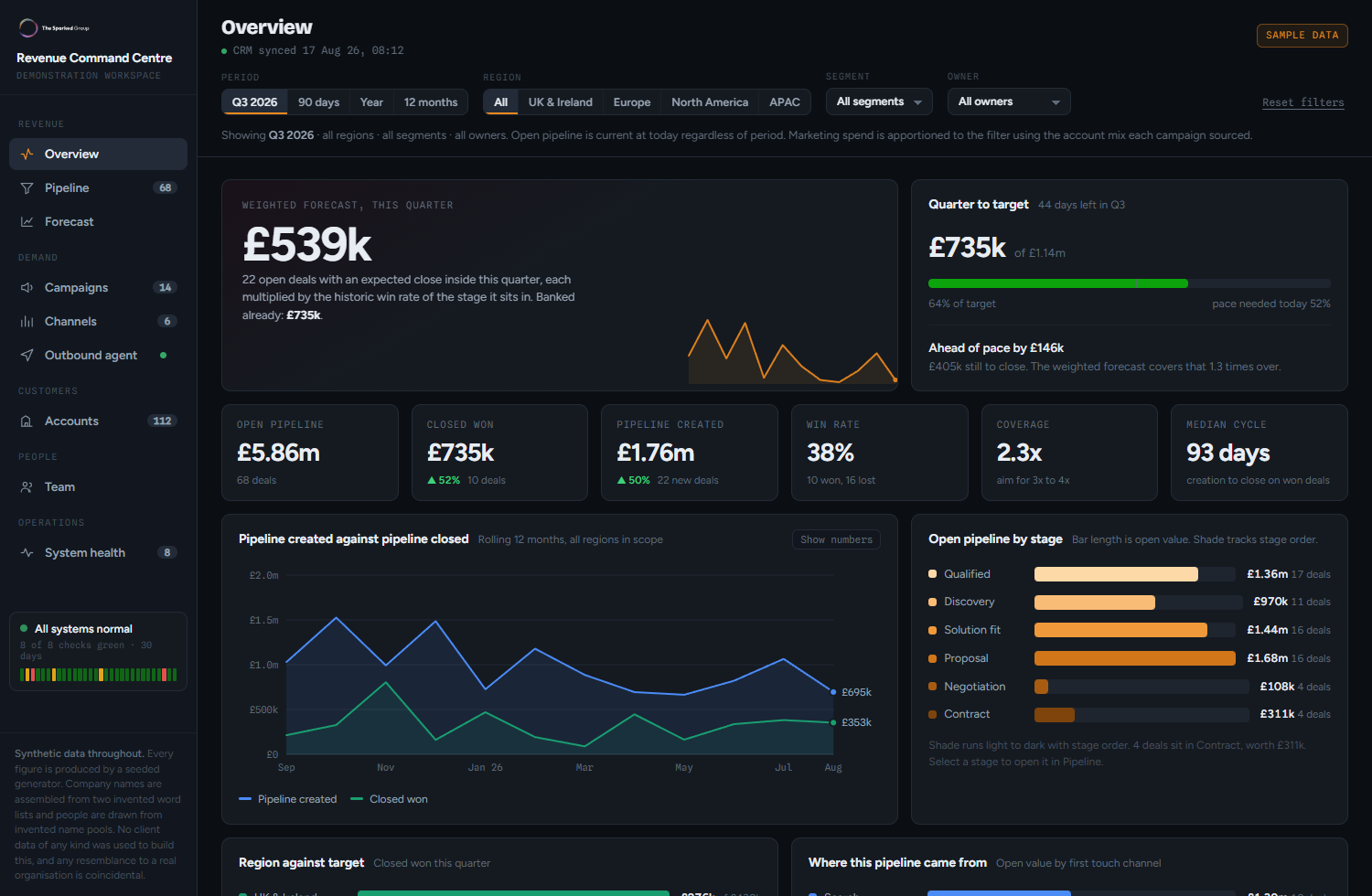
See the engine running
Most dashboards get shown as a screenshot in a deck. This one you can click. It is a full revenue command centre with nine linked views, the kind we build and then run, and every number in it is synthetic, so nothing is hidden behind a redaction box. Filter it, sort it, open a deal, open a campaign, and break something on purpose.
revenue command centre · overview
What is inside
01Overview. Weighted forecast, quarter to target, coverage, and the deals that need attention today.
02Pipeline. Every open opportunity, its qualification gates, its activity and the campaign that created it.
03Forecast. Commit, best case and weighted read against the same target, with stage conversion behind them.
04Campaigns. Spend, response and the pipeline that followed, down to ad sets and sequence steps.
05Channels. Six channels carried all the way through to closed revenue, with a conversion matrix.
06Source detail. Grouped by utm_source, medium, campaign or content, and first touch set against last touch.
07Outbound agent. A live activity feed, the guardrails it works inside, and its signal radar.
08Accounts. Fit against engagement, buying group coverage, and the pipeline sitting behind a thin group.
09System health. The eight checks feeding all of it, with an outage drill you can set off yourself.
Open the demo
Four details and you are in.
It opens in this tab straight away. No password to remember and nothing to install.
We will follow up once. Tell us to stop and we stop. See the privacy notice.
On the data. Every figure in the demo comes from a seeded generator. Company names are assembled from two invented word lists, the people are drawn from invented name pools, and no client record of any kind was used to build it. Any resemblance to a real organisation is coincidental.
The Sparked Group · Products
Our products.
Software for the creative and founder economy, run on the same engine we sell. Each one solves a problem we felt ourselves first.
The agentic go-to-market command centre. 52 agents across 10 specialist squads handle strategy, content, sales and growth. From market research to closed deals, running while you sleep.
A shared home for client requests, progress, reviews and sign-off. Keep your team and clients close to the work, with white-label options for your agency.
Tell us which process is taking too much time, where work gets stuck or what you would like to build. Choose a time in the diary to talk it through, or send a message below.
Our Dreamers lists software from independent founders next to the products we build ourselves. Tell us about yours. If it is a good fit, we publish a page for it and give you a LinkedIn post and an image to announce it.
A page of its own
Your logo, description, key features, pricing and a link to your site, on its own page under thesparkedgroup.com/our-dreamers.
A launch kit to share it
A LinkedIn post that tags The Sparked Group and a 1200 by 627 share image, ready as soon as you submit.
Read by a person
Josh reviews every submission. Nothing is published until he approves it, and we may turn down listings that are not a good fit.
You can ask us to change or remove your listing at any time by emailing [email protected]. Our privacy notice explains how we handle your details.
Submit your product
Every field is required unless it says optional. Have your logo file ready.
Thanks. We have your submission.
Josh reads every submission before anything is published. We will be in touch by email.